
Community Development

Setting the Stage for a More Flourishing Society
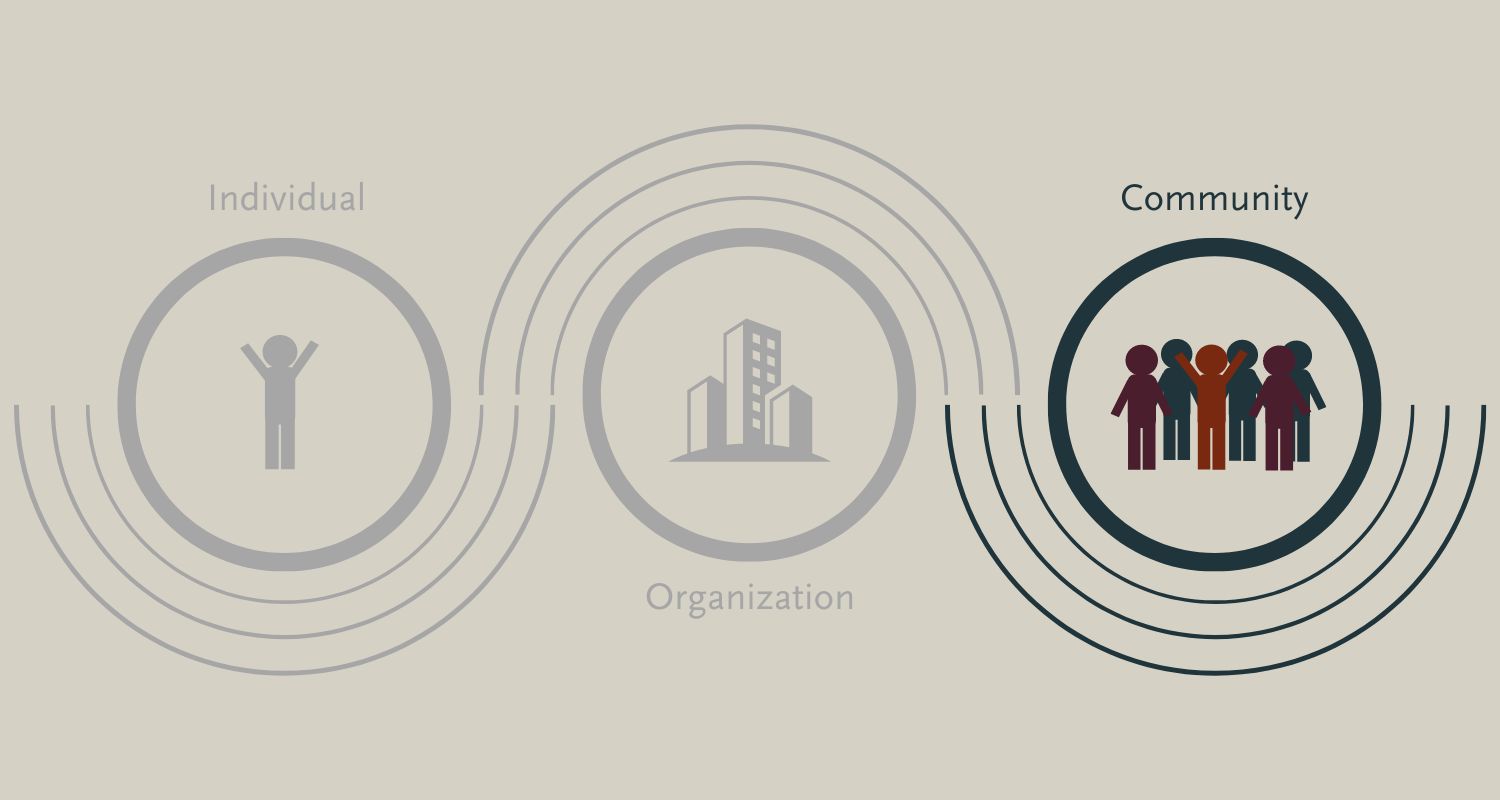
As leaders, teams, and organizations become healthier, they are better able to handle crises and to care for changing communities and shifting society contexts.

Markers of Flourishing Communities

We envision a future where more good leaders and higher capacity organizations work together to restore trust in one another and in institutions, which sets the stage for a more flourishing society. We imagine a world where:

Leaders face reality.

They look at the presence of complex problems, working with the anxiety and fear of the situation, and staying in curious conversation to share and listen across different viewpoints about how best to solve the problem.

People aren’t frightened.

They aren’t afraid of their neighbor, because they know their neighbor’s name and story.

Dignity and respect are primary.

People are first and foremost seen as children of God and worthy of care, before they are citizens or consumers; A society in which creation is seen as God’s “very good” gift to humanity to be stewarded and enjoyed, and never exploited.

The Importance of Place 

We live, work, and serve within a context – in a specific time, place, and culture. To be most effective as a changemaker, we must become a student of our place; our person, organization and community.

Building a flourishing society feels aspirational, but as we each focus right where we are, our thousands of small movements build towards a collective impact.

“Ours is not the task of fixing the entire world all at once, but of stretching out to mend the part of the world that is within our reach. Any small, calm thing that one soul can do to help another soul, to assist some portion of this poor suffering world, will help immensely.” – Clarissa Pinkola Estes

Offerings to Impact Your Community

CTE programs provide leaders with a replicable process to understand identity, belonging, and mission in their context.

Thriving Communities Workshops
A variety of workshops that guide you through the process of learning to listen well, analyze, and implement more effective ways of being and servicing in your context. 

Christ & Cascadia
This online publication highlights expressions of Christian faith communities in the Cascadia bioregion.

Christ & Cascadia Annual Gathering
Every spring we hold an event that gathers people from all over the greater Cascadia region to focus on questions and issues specific to our place and time. This event is designed to facilitate the exchange of ideas among Christ followers to explore, imagine, and create the future of Christianity in Cascadia.

Compelling Preaching Annual Gathering
This event will offer preaching inspiration, tools, and practices. Guest lecturers will speak on an aspect of preaching, innovative faith communities and how it intersections of text, soul, and culture

Full attendance and participation during all sessions are expected to complete the program.
Terms / Conditions. By registering for a Resilience or Leaders Circle, you agree to the following (scroll down and click agree)
Please consider the schedule closely to ensure you will be able to participate in the virtual meetings, and block off your calendar to ensure your attendance. Should you have an emergency (illness, situations out of your control) that will impact your participation please email transforming@theseattleschool.edu
Time commitment:
Two hours one day per month for 8 months, dates to be determined by majority of registrants' availability and adjusted as needed during the first group meeting.
Your feedback is immensely valuable!
As an essential component of your participation in this program, we ask that you provide us with your honest, candid, and timely feedback in program surveys and conversations, and consider providing reviews or testimonials of the program for promotional use.
Code of Conduct:
The Center for Transforming Engagement strives for intentionality in the ways we relate to one another - how we as a team relate to each other, how we relate to participants, and how we hope participants will relate to us and one another. To that end, we hold cultural norms about the ways we interact with one another. Your participation in this program is contingent on your agreement to abide by these cultural norms. i. For growth to happen, we all need to be able to share about the deeper challenges we face. To provide that atmosphere of openness and support, you commit to not sharing personal information that is shared in program meetings. ii. In our interactions with each other and our communities, we practice the humility of not-knowing that is required to listen and discover. iii. Be aware of different cultural and characterological ways of communicating, and invite others’ voices. Respect theological differences: the river of Christian orthodoxy is wide, and while the streams of that river are distinct, they are not inherently better or worse. Even if you can’t respect the belief, treat the person with respect. iiii. We value both thoughts and feelings as valuable pieces of information that inform one another, and inform our learning and discerning together. iv. Be in the here and now (not mentally somewhere or some time else), with the people who are sharing their time and stories with you. Eliminate any distractions possible.
Fair Use Policy
All program content, recordings, and materials are the intellectual property of The Seattle School and may not be presented, distributed, or replicated. The Seattle School retains the copyright for all recorded content. Some print materials (PDFs, worksheets, journal prompts, etc.) will be licensed under Creative Commons: Attribution NonCommercial ShareAlike. Those materials will be available for download on our website, and may be used as long as the following conditions are met: (1) attribute to the Center for Transforming Engagement even if remixed/modified; (2) do not use for commercial (paid) purposes; and (3) anything you make that remixes or builds upon this material, you must also distribute under Creative Commons. More information on this license is available at creativecommons.org/licenses/by-nc-sa/3.0/
(scroll down and click agree) Full attendance and participation during all sessions are expected to complete the program. Please consider the schedule closely to ensure you will be able to participate in the virtual meetings, and block off your calendar to ensure your attendance. Should you have an emergency (illness, situations out of your control) that will impact your participation please email transforming@theseattleschool.edu Time commitment: Two hours one day per month for 8 months, dates to be determined by majority of registrants' availability and adjusted as needed during the first group meeting. Your feedback is immensely valuable! As an essential component of your participation in this program, we ask that you provide us with your honest, candid, and timely feedback in program surveys and conversations, and consider providing reviews or testimonials of the program for promotional use. 2. Code of Conduct The Center for Transforming Engagement strives for intentionality in the ways we relate to one another - how we as a team relate to each other, how we relate to participants, and how we hope participants will relate to us and one another. To that end, we hold cultural norms about the ways we interact with one another. Your participation in this program is contingent on your agreement to abide by these cultural norms. Confidentiality. For growth to happen, we all need to be able to share about the deeper challenges we face. To provide that atmosphere of openness and support, you commit to not sharing personal information that is shared in program meetings. Curiosity. In our interactions with each other and our communities, we practice the humility of not-knowing that is required to listen and discover. Respect differences. Be aware of different cultural and characterological ways of communicating, and invite others’ voices. Respect theological differences: the river of Christian orthodoxy is wide, and while the streams of that river are distinct, they are not inherently better or worse. Even if you can’t respect the belief, treat the person with respect. You are invited to be a whole person, with both thoughts and feelings. We value both thoughts and feelings as valuable pieces of information that inform one another, and inform our learning and discerning together. Presence. Be in the here and now (not mentally somewhere or some time else), with the people who are sharing their time and stories with you. Eliminate any distractions possible. 3. Fair Use Policy All program content, recordings, and materials are the intellectual property of The Seattle School and may not be presented, distributed, or replicated. The Seattle School retains the copyright for all recorded content. Some print materials (PDFs, worksheets, journal prompts, etc.) will be licensed under Creative Commons: Attribution NonCommercial ShareAlike. Those materials will be available for download on our website, and may be used as long as the following conditions are met: (1) attribute to the Center for Transforming Engagement even if remixed/modified; (2) do not use for commercial (paid) purposes; and (3) anything you make that remixes or builds upon this material, you must also distribute under Creative Commons. More information on this license is available at creativecommons.org/licenses/by-nc-sa/3.0/
Lina Thompson is the lead Pastor at Lake Burien Presbyterian Church. Her primary vocation and call is the formation of leaders who love and serve their city and seek its peace.
Silas Sham is the Lead Pastor of Bethany Community Church Northeast in Seattle and holds a Doctor of Ministry in Semiotics, Church, and Culture from Portland Seminary. His research explores how food can form and reflect theological imagination. He created Theology on a Plate, a gamified discipleship experience that brings people around the table to taste, tell, and practice the story of God. His work has been published through the Society of Biblical Literature and in various theological and ministry journals, and he believes the best theology is lived, savored, and shared in community to nourish all of creation.
Rev. Danielle Merseles is the current Associate Pastor of Youth and Young Adults at Bethany Presbyterian Church, Seattle. After an unexpected yes to volunteering in youth ministry back in 2011, Danielle eventually enrolled in seminary at Seattle Pacific, did a unit of chaplaincy at Harborview, and became ordained in the PC(USA). She loves regularly teaching and learning from people younger than her and has been called to Bethany for nearly 10 years now. She is a New Jersey native, Tulane University School of Architecture graduate, hobby potter, loves being auntie/godmother to her friends small people, and has called Seattle home since 2007.
Jessica became disabled as a young adult and has worked for accessibility and inclusion specifically in third places for over 20 years. Coming to the Episcopal Church after experiencing religious trauma from “faith healing,” Jessica feels called to break down barriers, both physical as well as spiritual by addressing the harmful theologies and behaviors that have shown disabled people that “we are not welcome as the Beloved People God created us to be.” She is blogger, speaker, and consultant for Bridge Disability Ministries.
The Rev. Dr. Leah D. Schade is the Associate Professor of Preaching and Worship at Lexington Theological Seminary in Lexington, Kentucky, and served as the President of the Academy of Homiletics in 2024. An ordained Lutheran minister (ELCA) for nearly twenty-five years, Leah earned both her MDiv and PhD degrees from the Lutheran Theological Seminary at Philadelphia (now United Lutheran Seminary). She has pastored congregations in suburban, urban, and rural contexts. She is the author of seven books, including Preaching and Social Issues: Tools and Tactics for Empowering Your Prophetic Voice (Rowman & Littlefield, 2025), and Preaching in the Purple Zone: Ministry in the Red-Blue Divide (Rowman & Littlefield, 2019).
The Rev. Natalie "Nat" Johnson serves as Priest in Charge at St Peter's, a diverse and multi-ethnic Episcopal parish in Seattle WA. Over the last five years, Rev. Nat has served on the Diocese of Olympia's Commission on Ministry, walking with individuals sensing a call to ordained ministry. They also currently serve as Affiliated Faculty at Church Divinity School of the Pacific where they teach Liturgical Theology to seminarians preparing for the priesthood in the Episcopal Church.
Rev. Bruce Reyes-Chow is a 3rd Generation Filipino/Chinese American and an active speaker, writer, and coachsultant. His writing, teaching, and speaking have taken him to Australia, The Philippines, Japan, Taiwan, Canada, and across the United States as he addresses topics of faith, leadership, activism, culture, race, and technology. Author of six books, most recently, In Defense of Kindness: Why It Matters, How It Changes Our Lives, and How It Can Save the World (Chalice Press, 2021) Everything Good about God is True: Choosing Faith (Broadleaf Books, 2024). Bruce also has a broad online video and audio presence but writes and podcasts through his Newsletter & Podcast, The Amalgamation. Bruce has been an ordained minister in the Presbyterian Church (USA) since 1995 and has pastored seven congregations throughout California. In 2008, he was elected Moderator of the Presbyterian Church USA, the youngest and first Asian American to hold the denomination’s highest elected office. He currently sits on the Board of Directors of Interfaith Movement for Human Integrity, works with Sabeel Ecumenical Liberation Theology Center to lead delegations to Palestine, is a Senior Consultant and Coach with Convergence, is a Gallup-Certified CliftonStrengths Coach, and is the Church Relations and Development Officer at Zephyr Point Conference Center. Bruce and his wife, Robin, have three adult children, two senior pups, too many houseplants, and a thriving empty-nester life in San Jose, CA.