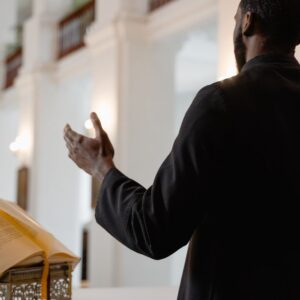
Advent Love for the Tearful Strong

December 17, 2025

I’m a strong person. Or at least, people perceive me as a strong person. It’s usually spoken as a compliment, but it’s actually kind of a problem.

Growing up, I would find somewhere to hide when I started crying — the back of a closet, buried behind the coats; beneath a wardrobe; when I was very young, behind the changing table. By the time I was out of diapers, no one would come to comfort me. My family saw me as independent; they knew I’d cry myself out and be fine. They believed that I was strong.

As an adult, not much has changed. On a medical leave of a few months, only two friends reached out. People told themselves that I would handle myself, that I was strong.

My partner is the only person who I allow to see me really cry, and it took over a decade together before I trusted him with that. He rubs my back or holds me and doesn’t say anything. More importantly, he doesn’t panic or get anxious. He just breathes and lets me feel my feelings, and stays with me through it.

I fell in love with him because I could feel his desire to grow my spirit. He was a stable place to stand as my ministry made me more visible; he encouraged me through each step of my education and career.

But now, I recognize that the biggest gift of love he gives me is allowing me to be vulnerable, to need care, to be fragile. In a world that expects and demands my strength, he gives me the gift of a place where I don’t need to be strong; I can just be me.

I wonder if this is the gift that Mary gives to the divine force of the universe when she says “yes” to the preposterous proposal of conception. If that Almighty Power really needed to be allowed to be small, to be seen not only as powerful but as vulnerable. In carrying, birthing, and caring for Jesus, Mary loves God by letting them shrink to the size of cells. She doesn’t love God by adoring how strong they are; she loves God by holding their weakness. She doesn’t offer God a throne, but a womb and a breast; her life, rearranged for the smallness of God, the mundane reality of tending to God one feeding at a time.

From the moment of incarnation, God is signaling to us that we’ve gotten it all wrong. We’re waiting for a powerful force to show up, deliver vengeance against our enemies, overthrow our oppressors. But that’s not the nature of God, as we find out alongside the disciples when they watch their Messiah tortured and murdered at the hands of the state. The nature of God is be honest about their need for care, their need for love.

Recently, I was reading the first book in bell hooks’ “love song to the nation,” All About Love: New Visions. In it, she writes that love is an action; she adopts psychologists’ definition of love as “the will to extend one’s self for the purpose of nurturing one’s own or another’s spiritual growth.” By this definition, Mary certainly loves the divine, extending her body in a very literal way for the growth and nurturance of Jesus. Her ‘yes’ is for her spiritual growth, and also for another’s spiritual growth — Joseph’s, all humanity’s, God themselves.

Most of us don’t want a love that is this messy. We watch so-called romance movies with misunderstandings that will become cute, funny stories for the couple later on. We prefer clear communication and no one crying at inconvenient times.

But the love of Advent invites us into a love like the one that Mary models for us. Advent invites us to make room for another’s vulnerability, even when it complicates entire belief systems, even when it means giving up the desire for a powerful divinity who will make the world “right.” A love that costs us our comfort, and comes with no guarantees.

This week, I’m wondering about where I need to love more like Mary. Where do I see someone as powerful over me, and could I be invited to see their smallness — their hurt, their fear? Where am I holding my life so tightly that no one else’s needs can fit? Where might I find a little space to care for, to carry, another?

And, of course, because I buy into the own myth of my strength, I must also wonder about how I might learn about spiritual growth from God’s move into the womb. What power do I have that I can recognize and use differently, share, or perhaps set aside? When might I need to ask for more space, instead of trying to accommodate everyone around me? Where do I need to ask to be carried, even if just for a moment?

If God chooses smallness, maybe love does too. Strength shouts, but love whispers. Strength screams its certainties, but love arrives the way God did in Mary: a dream, a word, utterly dependent on others.

The turning point of history is a newborn’s wail at the harshness of the world, in the arms of a no-status woman in the garage of a nothing town. That’s the whole point. Love grows in the most vulnerable places — of ourselves, and of the world. That’s how God came near once. It’s where God comes near now.

Become More Resilient.
When you invest in your personal resilience, you are also building the resilience of the communities around you. Start today with our free Self-Facilitated Resilience Retreat Guides.

Upcoming Events

No Events Found

0 Comments

Submit a Comment

Your email address will not be published. Required fields are marked *

Full attendance and participation during all sessions are expected to complete the program.
Terms / Conditions. By registering for a Resilience or Leaders Circle, you agree to the following (scroll down and click agree)
Please consider the schedule closely to ensure you will be able to participate in the virtual meetings, and block off your calendar to ensure your attendance. Should you have an emergency (illness, situations out of your control) that will impact your participation please email transforming@theseattleschool.edu
Time commitment:
Two hours one day per month for 8 months, dates to be determined by majority of registrants' availability and adjusted as needed during the first group meeting.
Your feedback is immensely valuable!
As an essential component of your participation in this program, we ask that you provide us with your honest, candid, and timely feedback in program surveys and conversations, and consider providing reviews or testimonials of the program for promotional use.
Code of Conduct:
The Center for Transforming Engagement strives for intentionality in the ways we relate to one another - how we as a team relate to each other, how we relate to participants, and how we hope participants will relate to us and one another. To that end, we hold cultural norms about the ways we interact with one another. Your participation in this program is contingent on your agreement to abide by these cultural norms. i. For growth to happen, we all need to be able to share about the deeper challenges we face. To provide that atmosphere of openness and support, you commit to not sharing personal information that is shared in program meetings. ii. In our interactions with each other and our communities, we practice the humility of not-knowing that is required to listen and discover. iii. Be aware of different cultural and characterological ways of communicating, and invite others’ voices. Respect theological differences: the river of Christian orthodoxy is wide, and while the streams of that river are distinct, they are not inherently better or worse. Even if you can’t respect the belief, treat the person with respect. iiii. We value both thoughts and feelings as valuable pieces of information that inform one another, and inform our learning and discerning together. iv. Be in the here and now (not mentally somewhere or some time else), with the people who are sharing their time and stories with you. Eliminate any distractions possible.
Fair Use Policy
All program content, recordings, and materials are the intellectual property of The Seattle School and may not be presented, distributed, or replicated. The Seattle School retains the copyright for all recorded content. Some print materials (PDFs, worksheets, journal prompts, etc.) will be licensed under Creative Commons: Attribution NonCommercial ShareAlike. Those materials will be available for download on our website, and may be used as long as the following conditions are met: (1) attribute to the Center for Transforming Engagement even if remixed/modified; (2) do not use for commercial (paid) purposes; and (3) anything you make that remixes or builds upon this material, you must also distribute under Creative Commons. More information on this license is available at creativecommons.org/licenses/by-nc-sa/3.0/
(scroll down and click agree) Full attendance and participation during all sessions are expected to complete the program. Please consider the schedule closely to ensure you will be able to participate in the virtual meetings, and block off your calendar to ensure your attendance. Should you have an emergency (illness, situations out of your control) that will impact your participation please email transforming@theseattleschool.edu Time commitment: Two hours one day per month for 8 months, dates to be determined by majority of registrants' availability and adjusted as needed during the first group meeting. Your feedback is immensely valuable! As an essential component of your participation in this program, we ask that you provide us with your honest, candid, and timely feedback in program surveys and conversations, and consider providing reviews or testimonials of the program for promotional use. 2. Code of Conduct The Center for Transforming Engagement strives for intentionality in the ways we relate to one another - how we as a team relate to each other, how we relate to participants, and how we hope participants will relate to us and one another. To that end, we hold cultural norms about the ways we interact with one another. Your participation in this program is contingent on your agreement to abide by these cultural norms. Confidentiality. For growth to happen, we all need to be able to share about the deeper challenges we face. To provide that atmosphere of openness and support, you commit to not sharing personal information that is shared in program meetings. Curiosity. In our interactions with each other and our communities, we practice the humility of not-knowing that is required to listen and discover. Respect differences. Be aware of different cultural and characterological ways of communicating, and invite others’ voices. Respect theological differences: the river of Christian orthodoxy is wide, and while the streams of that river are distinct, they are not inherently better or worse. Even if you can’t respect the belief, treat the person with respect. You are invited to be a whole person, with both thoughts and feelings. We value both thoughts and feelings as valuable pieces of information that inform one another, and inform our learning and discerning together. Presence. Be in the here and now (not mentally somewhere or some time else), with the people who are sharing their time and stories with you. Eliminate any distractions possible. 3. Fair Use Policy All program content, recordings, and materials are the intellectual property of The Seattle School and may not be presented, distributed, or replicated. The Seattle School retains the copyright for all recorded content. Some print materials (PDFs, worksheets, journal prompts, etc.) will be licensed under Creative Commons: Attribution NonCommercial ShareAlike. Those materials will be available for download on our website, and may be used as long as the following conditions are met: (1) attribute to the Center for Transforming Engagement even if remixed/modified; (2) do not use for commercial (paid) purposes; and (3) anything you make that remixes or builds upon this material, you must also distribute under Creative Commons. More information on this license is available at creativecommons.org/licenses/by-nc-sa/3.0/
Lina Thompson is the lead Pastor at Lake Burien Presbyterian Church. Her primary vocation and call is the formation of leaders who love and serve their city and seek its peace.
Silas Sham is the Lead Pastor of Bethany Community Church Northeast in Seattle and holds a Doctor of Ministry in Semiotics, Church, and Culture from Portland Seminary. His research explores how food can form and reflect theological imagination. He created Theology on a Plate, a gamified discipleship experience that brings people around the table to taste, tell, and practice the story of God. His work has been published through the Society of Biblical Literature and in various theological and ministry journals, and he believes the best theology is lived, savored, and shared in community to nourish all of creation.
Rev. Danielle Merseles is the current Associate Pastor of Youth and Young Adults at Bethany Presbyterian Church, Seattle. After an unexpected yes to volunteering in youth ministry back in 2011, Danielle eventually enrolled in seminary at Seattle Pacific, did a unit of chaplaincy at Harborview, and became ordained in the PC(USA). She loves regularly teaching and learning from people younger than her and has been called to Bethany for nearly 10 years now. She is a New Jersey native, Tulane University School of Architecture graduate, hobby potter, loves being auntie/godmother to her friends small people, and has called Seattle home since 2007.
Jessica became disabled as a young adult and has worked for accessibility and inclusion specifically in third places for over 20 years. Coming to the Episcopal Church after experiencing religious trauma from “faith healing,” Jessica feels called to break down barriers, both physical as well as spiritual by addressing the harmful theologies and behaviors that have shown disabled people that “we are not welcome as the Beloved People God created us to be.” She is blogger, speaker, and consultant for Bridge Disability Ministries.
The Rev. Dr. Leah D. Schade is the Associate Professor of Preaching and Worship at Lexington Theological Seminary in Lexington, Kentucky, and served as the President of the Academy of Homiletics in 2024. An ordained Lutheran minister (ELCA) for nearly twenty-five years, Leah earned both her MDiv and PhD degrees from the Lutheran Theological Seminary at Philadelphia (now United Lutheran Seminary). She has pastored congregations in suburban, urban, and rural contexts. She is the author of seven books, including Preaching and Social Issues: Tools and Tactics for Empowering Your Prophetic Voice (Rowman & Littlefield, 2025), and Preaching in the Purple Zone: Ministry in the Red-Blue Divide (Rowman & Littlefield, 2019).
The Rev. Natalie "Nat" Johnson serves as Priest in Charge at St Peter's, a diverse and multi-ethnic Episcopal parish in Seattle WA. Over the last five years, Rev. Nat has served on the Diocese of Olympia's Commission on Ministry, walking with individuals sensing a call to ordained ministry. They also currently serve as Affiliated Faculty at Church Divinity School of the Pacific where they teach Liturgical Theology to seminarians preparing for the priesthood in the Episcopal Church.
Rev. Bruce Reyes-Chow is a 3rd Generation Filipino/Chinese American and an active speaker, writer, and coachsultant. His writing, teaching, and speaking have taken him to Australia, The Philippines, Japan, Taiwan, Canada, and across the United States as he addresses topics of faith, leadership, activism, culture, race, and technology. Author of six books, most recently, In Defense of Kindness: Why It Matters, How It Changes Our Lives, and How It Can Save the World (Chalice Press, 2021) Everything Good about God is True: Choosing Faith (Broadleaf Books, 2024). Bruce also has a broad online video and audio presence but writes and podcasts through his Newsletter & Podcast, The Amalgamation. Bruce has been an ordained minister in the Presbyterian Church (USA) since 1995 and has pastored seven congregations throughout California. In 2008, he was elected Moderator of the Presbyterian Church USA, the youngest and first Asian American to hold the denomination’s highest elected office. He currently sits on the Board of Directors of Interfaith Movement for Human Integrity, works with Sabeel Ecumenical Liberation Theology Center to lead delegations to Palestine, is a Senior Consultant and Coach with Convergence, is a Gallup-Certified CliftonStrengths Coach, and is the Church Relations and Development Officer at Zephyr Point Conference Center. Bruce and his wife, Robin, have three adult children, two senior pups, too many houseplants, and a thriving empty-nester life in San Jose, CA.